Week 1
The Truth About Procrastination
What it actually is, why willpower isn't the answer, and the science that explains everything.
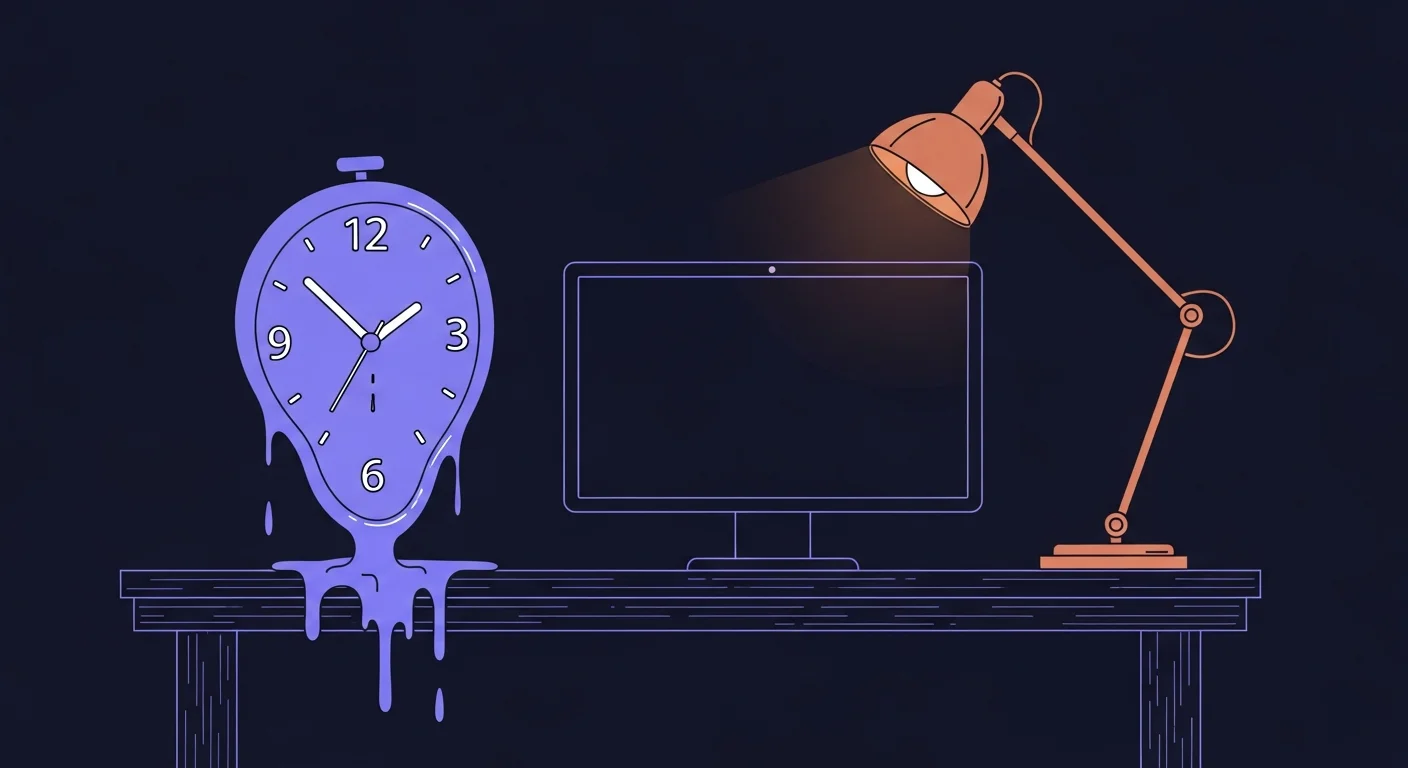
What procrastination actually is, why you do it, and why willpower was never going to save you.
Marcus
Marcus is thirty-four and he is disappearing.
Not in any dramatic way. No one has staged an intervention. No one has noticed, really, because Marcus is very good at looking like someone whose life is on track. He has a job — a good one, actually, though he has been in the same role for four years because the promotion requires a portfolio update he has not started. He has an apartment — the lease is fine, the rent is manageable, though he has been meaning to deal with the leak in the bathroom since November and it is now March. He has friends — fewer than he used to, because keeping up with people requires responding to messages and he has a backlog of thirty-seven that he thinks about every night before falling asleep.
Marcus is not lazy. Marcus works eight-hour days. Marcus spends his weekends in a state of low-grade panic about everything he should be doing, which looks a lot like lying on the couch scrolling his phone, which looks a lot like laziness if you do not know what is happening inside.
What is happening inside is a war. Every single day, Marcus wakes up with a list. Not a written list — a mental one, a rolling inventory of things he has been meaning to do for days or weeks or months. The portfolio. The leak. The messages. The dentist appointment he has rescheduled twice. The gym membership he is paying for and not using. The conversation with his mother he has been avoiding. The creative project that used to excite him and now fills him with dread.
He looks at the list and he feels everything — the urgency, the guilt, the determination. Today will be different. He will start with the portfolio. He opens his laptop. He stares at the screen. He checks the news. He makes coffee. He sits back down. He opens a blank document. The cursor blinks. His chest tightens. He closes the laptop.
It is 11 AM and the day is already lost, and Marcus knows this — he can feel the day slipping — and the knowing makes it worse because now there is the guilt of wasting the morning on top of everything else, and guilt is not fuel, guilt is quicksand, and by 3 PM Marcus is so deep in the shame of another wasted day that starting anything feels pointless.
He will try again tomorrow. Tomorrow will be different.
Marcus has been saying this for years.
Here is what Marcus does not know — what he cannot see from inside the pattern: there is nothing wrong with him. Not with his character, not with his work ethic, not with his intelligence. What is wrong is the strategy. The strategy of relying on willpower to overcome emotional avoidance. The strategy of treating procrastination as a discipline problem when it is actually a feeling problem. The strategy of beating himself up and expecting the beatings to eventually produce motivation.
The beatings never produce motivation. They produce shame. And shame is fuel for avoidance, not fuel for action.
Marcus does not need to try harder. He needs to understand what is actually happening — and then do something different. That is what this week is about.
What Procrastination Actually Is
If you see yourself in Marcus — even partially, even in one domain of your life — the first thing you need to know is that the story you have been telling yourself about why this happens is probably wrong.
The story most procrastinators tell themselves is simple: I am lazy. I lack discipline. I need more willpower. If I just tried harder, this would stop.
This story is not just wrong. It is the engine that keeps procrastination running.
Here is what the research actually says.
Procrastination is not a time management problem. This is the finding that changes everything. Dr. Timothy Pychyl, who has studied procrastination for over twenty years at Carleton University, puts it directly: procrastination is an emotion regulation problem, not a time management problem (Pychyl & Sirois, 2016). You do not procrastinate because you cannot manage your schedule. You procrastinate because you cannot manage your feelings about the task.
Think about the last time you procrastinated. Before you avoided the task, there was a feeling. Maybe anxiety. Maybe boredom. Maybe frustration. Maybe a subtle, hard-to-name dread. That feeling was unpleasant, and your brain did what brains are designed to do with unpleasant feelings — it moved away from the source. The task was associated with discomfort, so your brain found something more comfortable. Your phone. YouTube. Cleaning. Anything that offered immediate emotional relief.
This is not a failure of character. This is your nervous system working exactly as designed. The problem is that the relief is temporary and the consequences are cumulative.
The Procrastination Equation. Dr. Piers Steel, author of The Procrastination Equation (2007), formalized this into a model that is both useful and humbling:
Motivation = (Expectancy × Value) / (Impulsiveness × Delay)
In plain language: your motivation to do something increases when you believe you can succeed (Expectancy) and when the task feels meaningful or rewarding (Value). Your motivation decreases when you are easily distracted (Impulsiveness) and when the reward is far in the future (Delay).
Procrastination is not the absence of motivation. It is the result of a specific relationship between how much you believe in the outcome, how much you care about it, how distractible you are, and how distant the reward feels. This is why you can binge an entire season of a show (high value, immediate reward, low delay) and cannot start a project that matters to your career (uncertain outcome, delayed reward, high impulsiveness).
Temporal discounting — why your future self is a stranger. One of the cruelest features of the procrastinating brain is its relationship with time. Psychologist Hal Hershfield's research at UCLA (Hershfield et al., 2011) shows that when people think about their future selves, the brain activates regions associated with thinking about other people — strangers, essentially. Your brain treats future-you as someone else. Someone who will deal with the consequences. Someone who is, frankly, not your problem.
This is why you can knowingly make choices that harm your future self and feel genuinely fine about it in the moment. It is not irresponsibility. It is neurology. Your brain discounts future rewards and consequences the way it discounts money — a dollar today is worth more than a dollar next month, and a feeling today is more urgent than a consequence next quarter.
The shame-avoidance-shame cycle. Here is where procrastination becomes self-perpetuating. You avoid a task because it is associated with an unpleasant emotion. The avoidance provides temporary relief, which your brain registers as a reward. But then the consequences of avoidance accumulate — the deadline gets closer, the task gets bigger, the guilt gets heavier. Now the task is associated with even more unpleasant emotions than before — not just the original anxiety, but also the shame of having avoided it. Which makes the task even harder to approach. Which leads to more avoidance. Which leads to more shame.
This is the cycle that traps people for years. It is not a character flaw. It is a feedback loop, and like all feedback loops, it requires an intervention at a specific point to break it. Willpower is not that intervention. Understanding is.
Willpower is not the answer. If willpower worked, you would not be here. Not because you lack it — you likely have enormous reserves of willpower, which you burn through every day in the gap between wanting to do things and not doing them. The effort of not doing something while wanting to do it is exhausting. You are not saving energy by procrastinating. You are spending massive amounts of it on the internal battle.
Research on self-regulation consistently shows that willpower is a limited resource that depletes with use. Relying on willpower to overcome procrastination is like relying on a bucket to empty the ocean — technically possible, practically useless, and guaranteed to leave you feeling like you did not try hard enough.
What works instead: understanding your specific triggers, redesigning your environment, building systems that do not require daily heroism, and — critically — learning to be with uncomfortable emotions without reflexively running from them.
Procrastination versus strategic delay. One more distinction that matters. Not all delay is procrastination. Sometimes waiting is wise. Sometimes you genuinely need more information, more time, more processing before you act. The difference is emotional: strategic delay feels neutral or even positive. Procrastination feels like suffering. If you are delaying something and you feel guilty, anxious, or ashamed about the delay — that is procrastination. If you are delaying something and you feel calm, intentional, and confident that the timing is right — that is discernment.
Learn to tell the difference. This program is about the former, not the latter.
A note on Joseph Ferrari's research. Psychologist Joseph Ferrari at DePaul University has spent decades studying chronic procrastination — the kind that is persistent, pervasive, and resistant to change. His research reveals several important findings:
First, roughly 20% of adults are chronic procrastinators (Ferrari, O'Callaghan, & Newbegin, 2005). This is not a fringe condition. One in five people struggles with procrastination persistently enough for it to qualify as a chronic behavioral pattern.
Second, chronic procrastinators are not time management novices. They know how to manage time. They know what they need to do. They know when it needs to be done. The gap is not informational — it is behavioral. They cannot translate knowing into doing, because the emotional barrier is more powerful than the cognitive knowledge.
Third, procrastination is not a generation problem, a technology problem, or a modern problem. Ferrari's cross-cultural research shows that procrastination exists at similar rates across cultures, age groups, and historical periods. The tools of procrastination change (smartphones instead of daydreaming, Netflix instead of television), but the underlying pattern is ancient and universal.
This matters because it means the solution is not productivity hacks, time management tips, or "just put your phone away." Those address the symptoms. The cause — the emotional avoidance pattern — requires a different kind of intervention. The kind this program provides.
Exercise 1: The Procrastination Autopsy
This exercise is the foundation of everything that follows. Do not skip it.
Choose three recent episodes of procrastination. They can be large (a project you avoided for weeks) or small (an email you put off for a day). What matters is that they are real and recent.
For each episode, write down the following:
Episode 1:
- The task: What were you supposed to do? Be specific.
- The feeling: Before you avoided it, what did you feel? Not "I did not want to." Go deeper. Anxious? Bored? Overwhelmed? Afraid? Resentful? Confused? Unsure where to start?
- The escape: What did you do instead? Phone? Social media? Cleaning? Sleeping? Working on something easier? Helping someone else?
- The aftermath: What happened as a result of the avoidance? Did you eventually do it? At what cost? How did you feel after?
- The eventual trigger: If you did eventually do the task, what finally made you do it? Deadline pressure? Someone asking about it? Guilt reaching a threshold? A sudden burst of energy?
Episode 2: (Same five prompts.)
Episode 3: (Same five prompts.)
Now look at the patterns. Are the same emotions showing up across episodes? Are you escaping to the same places? Is there a common trigger that finally pushes you to act?
This is your procrastination fingerprint. It will look different from someone else's, and understanding yours is the first step toward interrupting it.
Why this matters: Most procrastinators have never examined their pattern this closely. They experience procrastination as a single, undifferentiated experience: "I could not make myself do it." But when you break it down — task, feeling, escape, aftermath, trigger — you discover that your procrastination follows a specific, predictable sequence. And predictable sequences can be interrupted. Not by willpower. By awareness.
Keep this autopsy. You will reference it again in later weeks as you build increasingly precise tools for each element of your pattern.
Exercise 2: The Emotion Beneath the Avoidance
Go back to your three episodes from Exercise 1. For each one, answer this question:
If I could not avoid this task — if avoidance was physically impossible — what feeling would I have to sit with?
Write the answer in one sentence. Examples:
- "I would have to sit with the fear that my work is not good enough."
- "I would have to sit with the frustration of doing something I did not choose."
- "I would have to sit with the confusion of not knowing where to start."
- "I would have to sit with the boredom of doing something that is not stimulating."
Now rate each emotion on a scale of 1 to 10: How intolerable does that feeling seem? Not how intolerable it is — how intolerable does it seem before you actually feel it?
Most people rate these feelings between 7 and 10. And here is the paradox that drives this entire program: the anticipated discomfort of a task is almost always worse than the actual discomfort of doing it. Your brain is generating a forecast, and the forecast is wrong. It is catastrophizing the emotional experience of the task in order to justify avoidance.
You do not need to fix this right now. You just need to see it.
A deeper practice for those who want it: For each of your three episodes, try this: close your eyes and imagine yourself in the moment just before avoidance. Not the moment of procrastination — the moment right before it. The moment when the task was in front of you and the emotion was rising. Stay there. Feel the feeling. What does it actually feel like in your body? Where is it — chest, stomach, throat, shoulders? What is its quality — tight, heavy, buzzing, numb?
Now imagine yourself staying with that feeling for thirty seconds instead of escaping it. Not doing the task — just not running from the feeling. What happens? For most people, the imagined experience reveals that the feeling — the one they have been fleeing for months or years — is uncomfortable but survivable. It does not actually destroy you. It just... hurts a little. And you can survive "hurts a little." You have survived much worse.
The discovery that the anticipated emotion is worse than the actual emotion is one of the most transformative realizations in this entire program. It does not happen from reading about it. It happens from practicing it. Stay with the feeling, even briefly, and the forecast starts to update.
Journaling Prompts
Spend ten to fifteen minutes with one or more of these prompts. Write without editing. Do not try to be insightful — try to be honest.
- What is the story I tell myself about why I procrastinate? Where did that story come from? Is it true?
- If procrastination is not laziness but emotional avoidance, what am I most afraid of feeling?
- Think of a time you pushed through procrastination and did the thing. What was the experience of doing it actually like compared to what you expected?
- If I could change one thing about my relationship with procrastination starting this week, what would it be?
Weekly Reframe
Procrastination is not evidence that something is wrong with you. It is evidence that your brain is trying to protect you from something that feels threatening — and the protection has become more damaging than the threat. The goal is not to become someone who never avoids. The goal is to become someone who can feel the urge to avoid, understand what is beneath it, and choose to act anyway.
If You Do One Thing This Week
Do the Procrastination Autopsy (Exercise 1). Write down three recent episodes of procrastination — task, feeling, escape, aftermath, trigger. This is the foundation everything else builds on. It takes fifteen minutes and it will change how you see your avoidance patterns forever.
Profile-Specific Notes
Fear-Based Avoiders: This week, pay special attention to how often the emotion beneath your avoidance is some form of fear — fear of failure, fear of judgment, fear of not being good enough. You are not avoiding tasks. You are avoiding the emotional exposure that tasks represent. Name it when you see it.
Rebels: Notice how many of your procrastination episodes involve tasks that feel imposed by someone else — or by a version of yourself that feels like someone else (your "responsible" self, your "should" self). The resistance is data. Do not judge it — just notice how often it shows up.
Overwhelmed: When you do Exercise 1, pay attention to the feeling of "I do not know where to start." That feeling is your signature. This week, just notice how often complexity — not difficulty, but complexity — is what stops you. A hard task with one clear step might be fine. An easy task with ten unclear steps might be impossible.
Thrill-Seekers: Your Procrastination Autopsy will likely reveal a pattern: you waited, the deadline approached, and then you did it — and it was fine. This week, I want you to also notice the cost. Not the outcome, but the cost — the stress, the sleep you lost, the quality you sacrificed, the other things you neglected while sprinting. The outcome was fine. Was the process?